
The triangle scarf is officially the breakout knit accessory of 2025 and 2026. From Paris Fashion Week to runway appearances at Bottega Veneta, Miu Miu, and Emporio Armani, the triangle scarf knitting pattern has gone from a classic knitting staple to a must-have fashion statement. And the best part? A triangle scarf is one of the easiest knit projects you can make.
Whether you call it a triangle scarf, bandana scarf, neckerchief, or shawlette, this simple knit scarf pattern is quick to make, endlessly wearable, and perfect for every skill level. This guide covers everything you need to know about knitting a triangle scarf: construction methods, yarn choices, sizes, styling tips, and why this easy knit scarf pattern is trending everywhere right now.

Why Triangle Scarves Are Trending Everywhere
The triangle scarf trend has been building steadily since late 2025, and in 2026, it shows no signs of slowing down. Here's why this knit scarf pattern is having such a massive moment:
Celebrity and Runway Endorsement
Kendall Jenner wore Almina Concept's triangle scarf during Paris Fashion Week in October 2025. It sold out in all four colors almost immediately. Hailey Bieber and Dakota Johnson were also spotted wearing triangle scarves. By 2026, Gigi Hadid pushed the trend forward with bandana-print scarf styling. On the runway, triangle and ascot-style knit scarves appeared in collections from Bottega Veneta, Miu Miu, Emporio Armani, Khaite, The Row, Burberry, and Ferragamo.
Fashion Press Coverage
The Everygirl called the triangle scarf "The Must-Have Accessory of 2025." The Zoe Report declared "Triangle Scarves Will Be a Leading Accessory in 2026." Marie Claire, Who What Wear, and Woman & Home have all published dedicated coverage. When this many fashion publications agree on a trend, it's real.
Why It Matters for Knitters
The triangle scarf is a runway-validated trend that knitters can make at home for a fraction of retail prices. A hand-knit triangle scarf or bandana scarf in quality yarn looks and feels more luxurious than anything off the rack. It's also one of the fastest, easiest knit patterns you can make, which makes it the perfect project for beginners or a satisfying quick knit for experienced knitters.

Triangle Scarf vs. Bandana Scarf vs. Shawl: What's the Difference?
These terms get used interchangeably in the knitting world, but there are real differences in size and function:
Bandana Scarf (Small Triangle)
A bandana scarf is a small triangle, roughly 40 to 47 inches wide and 10 to 13 inches deep. It uses about 50 to 100 grams of yarn (1 to 2 skeins) and can be knitted in a weekend. You wear it tied snug around the neck like a bandana, with the point in front. This is the size most aligned with the current fashion trend and is the most popular knit scarf pattern style right now.
Triangle Scarf (Medium)
A medium triangle scarf is roughly 55 to 75 inches wide and 15 to 21 inches deep. It uses about 150 to 200 grams of yarn and takes a few days to a week to knit. This size is the most versatile: you can drape it, wrap it, tie it, or wear it as a lightweight shawlette over your shoulders. This is the classic everyday knit scarf pattern size.
Shawl (Large Triangle)
An oversized triangle shawl has a wingspan of 80+ inches and a depth of 24 to 30+ inches. It uses 300 to 500+ grams of yarn and functions as a wrap or blanket scarf. This is the traditional shawl knitting pattern size, perfect for draping over shoulders on cool evenings.
The beauty of triangle scarf knitting patterns is that the same construction method works for all three sizes. You simply keep knitting until it's the size you want, then bind off. One easy knit pattern, three different accessories.

How to Knit a Triangle Scarf: Construction Methods
There are three main ways to construct a triangle scarf knitting pattern. All three produce a beautiful finished knit scarf, but they differ in complexity and how the fabric grows.
Bottom-Up (Point to Top Edge): The Easiest Method
This is the most beginner-friendly triangle scarf construction. You cast on just 3 stitches at the bottom point of the triangle and increase 2 stitches every other row (one on each edge) as you knit upward. The scarf grows wider with every row. Stop when it reaches your desired width and bind off.
This is the easiest knit scarf pattern for beginners because:
- You start with only 3 stitches, so there's almost no commitment at the beginning
- You watch it grow from a tiny point into a full triangle, which is incredibly satisfying
- You control the final size completely, just stop when it's big enough
- The increases can be simple: knit front and back (KFB) for beginners, or yarn overs for decorative eyelets along the edges
Top-Down (Center Neck Down): Classic Shawl Construction
In this method, you cast on at the center of the top neck edge and increase at each edge plus two at the center (4 increases total per right-side row). This creates a symmetrical triangle with a center spine running down the middle. It's the classic construction from the Shetland shawl knitting tradition and produces a beautiful, balanced knit scarf pattern.
Side-to-Side (Tip to Tip)
You cast on a few stitches at one tip, increase along one edge to the midpoint, then decrease back down to the other tip. This produces a triangle that grows and shrinks asymmetrically. Side-to-side construction is especially good for self-striping or gradient yarns, where the color changes create dramatic diagonal stripes across your knit scarf.
Best Stitch Patterns for Triangle Scarves
The stitch pattern you choose changes the look and feel of your finished knit triangle scarf:
- Garter stitch: The easiest option. Just knit every row. Lies completely flat (no curling), has a squishy, textured surface, and is perfect for beginners. If you can knit, you can make a garter stitch triangle scarf pattern.
- Stockinette with garter border: Smooth, classic fabric with a flat-lying garter stitch border that prevents curling. A more polished look than all-garter.
- Seed stitch or double seed stitch: Alternating knit and purl stitches create a pebbly, textured surface. Lies flat like garter stitch but with a more refined appearance. Purl Soho's popular Cloudberry Bandana uses double seed stitch.
- Lace or eyelet patterns: When you use yarn-over increases, the edges of your triangle scarf naturally create a lacy, eyelet detail with no extra effort. Beautiful for lightweight, airy knit scarf patterns.

Best Yarns for Knitting a Triangle Scarf
The yarn you choose shapes the entire character of your knit scarf pattern. Here are the best options by weight and fiber:
DK Weight: The Sweet Spot
DK weight yarn is the most popular choice for triangle scarf and bandana scarf knitting patterns right now. It creates a fabric with beautiful drape and warmth without being too heavy or bulky. It knits at a moderate pace and produces a refined-looking finished knit scarf. Purl Soho's viral Cloudberry Bandana uses DK cashmere, and Scarf No. 5 by My Favourite Things also uses a DK-weight cashmere.
Worsted Weight: Beginner-Friendly and Cozy
If you're knitting your first triangle scarf pattern, worsted weight is a great choice. The stitches are easy to see, the fabric grows quickly, and the finished knit scarf is warm and cozy. Merino wool like KnitPicks Swish Worsted is soft enough to wear against the neck all day.
Fingering Weight: Light and Elegant
For a delicate, lightweight knit scarf with beautiful drape, fingering weight yarn is ideal. It takes longer to knit but produces an airy, elegant triangle scarf that works beautifully as a neckerchief or lightweight shawlette.
Mohair-Silk Blends: The Trending Choice
Mohair-silk laceweight held double (two strands together) is one of the most popular yarn choices for triangle scarf knitting patterns right now. It creates a light, airy fabric with a beautiful halo effect that looks and feels luxurious. The ethereal, cloud-like texture photographs beautifully and captures the quiet luxury aesthetic perfectly.
Best Fiber Content
Merino wool is the gold standard for knit scarf patterns: soft against skin, excellent drape, and easy to care for in superwash versions. Cashmere is the luxury option and is what many of the most popular bandana scarf patterns call for. Alpaca blends add extra warmth and softness. For summer triangle scarves, cotton blends and linen are breathable and get softer with every wash.

Trending Colors for Triangle Scarves Knitting Patterns
Color choice can make your knit triangle scarf feel either timeless or fashion-forward. Here are the trending options:
Timeless Neutrals
- Cream and off-white: Pantone's 2026 Color of the Year is Cloud Dancer, a serene off-white. A cream triangle scarf goes with everything.
- Oatmeal and soft gray: Understated and effortlessly chic.
- Mocha and chocolate brown: Pantone's 2025 Color of the Year, Mocha Mousse, continues to influence knitwear. Brown tones are everywhere.
Statement Colors for 2026
- Cherry red: Bold, striking, and one of the dominant colors on 2026 runways.
- Cobalt blue: Dominated both Spring/Summer and Fall/Winter 2026 runway shows.
- Baby pink: Ubiquitous and expected to continue trending into 2027.
- Emerald green: Rich and jewel-toned for a luxe accent.
- Vibrant violet: A defining hue of the 2026 season.
For your first knit triangle scarf, a neutral like cream or oatmeal is the safest choice. For a second knit scarf that makes a statement, cherry red or cobalt blue will feel fresh and current. Bold stripes combining neutrals with one pop color are also trending.

How to Style a Triangle Scarf
One of the best things about the triangle scarf is how many ways you can wear it. Here are the most popular styling methods:
Classic Bandana Style
Drape the triangle with the point at your chest and tie the ends behind your neck. This is the most popular current way to wear a knit triangle scarf and the look that's been all over fashion press and street style. It works beautifully over a simple tee, a white button-down, or peeking out from under a coat.
Draped Over One Shoulder
Drape the triangle over one shoulder with the free end hanging down your back. Asymmetric and effortless. This works especially well with larger triangle scarves and shawlettes.
Wrapped Twice Around the Neck
For longer triangle scarves, wrap around your neck twice for a cozy, layered cowl effect. The triangle point tucks in naturally for a polished finish.
Over a Sweater (Knit on Knit)
Layer a knit triangle scarf over a matching or complementary knit sweater. This knit-on-knit styling is a fashion-insider finish that looks intentional and sophisticated. Try a cream bandana scarf over an oatmeal turtleneck with tailored trousers.
As a Headscarf
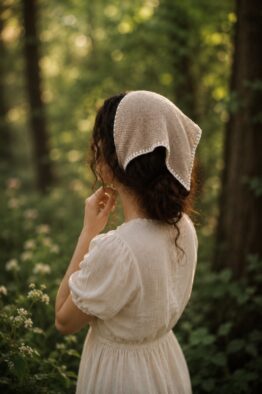
Worn over the head and tied under the chin, or wrapped around like a headband. This retro styling works particularly well with smaller knit bandana scarves and adds a romantic, vintage touch to any outfit.

Triangle Scarf Knitting Patterns to Try
Ready to cast on your own knit triangle scarf? Here are some of the most popular patterns:
Our own Air Scarf knitting pattern and The Ember Scarf knitting pattern at Darling Jadore are beautiful lightweight knit scarves that make perfect quick knit projects. And if you're looking for more knitting patterns, browse our full knitting pattern collection for sweaters, accessories, and more.

Tips for Knitting Your First Triangle Scarf
- Start with garter stitch or stockinette stitch. It's the easiest knit stitch pattern: just knit every row. No purling, no curling, and it looks beautiful in a triangle scarf. If you can knit, you can make this.
- Choose a yarn that feels good against your neck. A knit scarf sits directly on bare skin, so test your yarn against your neck before committing. Soft merino wool or cashmere blends are ideal.
- Use a stretchy bind-off. The top edge of a triangle scarf needs to be flexible so it drapes properly. A too-tight bind-off will make your knit scarf pucker along the top edge.
- Block your finished scarf. Soak in lukewarm water for 15 to 20 minutes, roll in a towel, then pin flat on blocking mats and let dry. Blocking opens up the stitches and transforms your knit scarf from "handmade" to "designer."
- Try it on as you knit. Since a triangle scarf grows from the point up, you can drape it around your neck at any point to check if the size feels right. Stop when you're happy with the width and depth.
- Add stitch markers at the edges. They help you remember which row is your increase row, especially if you're knitting while watching TV or chatting.

Frequently Asked Questions About Triangle Scarf Knitting Patterns
How many stitches do I cast on for a triangle scarf?
For a bottom-up triangle scarf knitting pattern, you typically cast on just 3 stitches. That's it. You increase 2 stitches every other row, and the triangle grows wider as you knit. It's one of the simplest cast-ons in all of knitting.
How much yarn do I need for a triangle scarf?
It depends on the size. A small bandana scarf uses about 50 to 100 grams (1 to 2 skeins). A medium triangle scarf uses about 150 to 200 grams (2 to 3 skeins). A large shawl-size triangle uses 300 to 500+ grams (4+ skeins). The beauty of this knit pattern is that you can stop at any size, so you can use whatever yarn you have.
Is a triangle scarf easy to knit for beginners?
Yes. A garter stitch triangle scarf is one of the easiest knit patterns a beginner can make. You only need to know two things: how to knit and how to do a basic increase (knit front and back). There are no complicated stitch patterns, no shaping, and no seaming. It's an ideal first knitting project after learning the basics.
What is the difference between a triangle scarf and a bandana scarf?
A bandana scarf is simply a small triangle scarf, typically 40 to 47 inches wide and 10 to 13 inches deep. It's designed to be worn snug around the neck like a bandana. A triangle scarf can be any size, from a small bandana to a full wrap-size shawl. The construction method is the same for all sizes.
What yarn weight is best for a triangle scarf?
DK weight is the most popular choice for triangle scarf and bandana scarf knitting patterns because it creates a fabric with great drape and warmth without being too heavy. Worsted weight is excellent for beginners who want a cozier, quicker-to-knit scarf. Fingering weight creates a more delicate, lightweight knit scarf.
Comments are closed.