

If you have ever opened a pattern, turned the page, and found a grid of little squares and symbols staring back at you, you are not alone. Learning how to read a knitting chart is one of those skills that feels intimidating at first and then suddenly clicks. Once it does, knitting charts often become the easiest way to follow lace, cables, textured knit stitches, and colorwork.
In this guide I will walk you through the basic rules every knitting chart follows, how to read the key, what to do with repeats and those mysterious grey squares, and a few simple tricks for keeping your place.
What Is a Knitting Chart?
A knitting chart is a visual map of your stitches. The basic idea is simple:

- Each square is one stitch. Each symbol or square on the chart represents one stitch or maneuver.
- Each horizontal row of squares is one row (or round) of knitting.
- The chart shows your fabric as seen from the right side. That single fact explains most of the rules below.
Because a knitting chart looks like the fabric you are making, many visual learners find it easier than written instructions. Charts can also be handy if a pattern was written in another language.
How to Read a Knitting Chart: The Basic Rules
1. Start at the bottom right corner
You will nearly always begin at the bottom right-hand corner of the chart and work your way up, one row at a time. Occasionally a pattern will tell you to start elsewhere, so always check the instructions that come with the chart.
2. Know which direction to read
For flat knitting (back and forth):
- Right side (RS) rows are read from right to left.
- Wrong side (WS) rows are read from left to right.
This mirrors what your hands are doing. You work a right side row from right to left, turn your work, and then the next row starts from what was the left edge. Following the chart this way, it snakes back and forth up the page.
For knitting in the round: every round is a right side round, so you read every round from right to left, from the bottom to the top.
3. Look at the row numbers
Row numbers tell you a lot. On a flat chart, odd-numbered rows are usually right side rows and appear on the right edge, and even-numbered rows are wrong side rows and appear on the left edge, right where each row begins.
- If the numbers run 1, 2, 3, 4, every row is shown on the chart.
- If the numbers run 1, 3, 5, 7, only right side rows are charted. The pattern will explain how to work the wrong side rows in between.
Charts for knitted colorwork usually show every row or round.

How to Read the Knitting Chart Key
Before you knit a single stitch, read through the key. Chart symbols are not fully standardized, and different publishers may use different symbols, so the key is your best friend.
Here are some symbols you will often see, but always confirm them in your pattern's key:
- Empty square: usually knit on a right side row.
- Dot or dash: purl on a right side row, or knit on a wrong side row.
- O: a yarn over.
- Slanted line: a decrease, leaning in the direction of the decrease.
- Symbols spanning several squares: cables. For example, a four-stitch cable takes up four squares on the chart.
Why a symbol can mean two things
Remember that the knitting chart shows the fabric from the right side. A stitch that looks like a knit on the right side is a purl when you are looking at the back of the fabric. That is why a blank square means knit on a right side row but purl on a wrong side row. The key usually lists both meanings, so you do not have to work it out yourself.

Repeats: Working the Boxed Section
Many knitting charts do not show a whole garment. Instead, they show a single repeat (or two) of a stitch pattern that you work across the row. Repeated sections are often outlined with a box, and the pattern will tell you where to begin and end the repeat.
A helpful habit is placing a stitch marker between each repeat. If your stitch count is off, you will spot it within one repeat rather than at the end of the row.
What Does a "No Stitch" Square Mean?
Sometimes you will see grey squares or an X labeled "no stitch" in the key. These squares are not stitches at all. They exist purely for chart readability, so the correct parts of the pattern line up on top of each other, typically after decreases or bind offs in earlier rows reduce the stitch count.
When you reach a no stitch square, you do nothing. Simply skip past it to the next real stitch. Do not knit it, purl it, or slip it.
A quick caution: in some colorwork charts, grey shading represents a yarn color rather than a no stitch. This is another reason to always check the key.
How to Read a Colorwork Chart
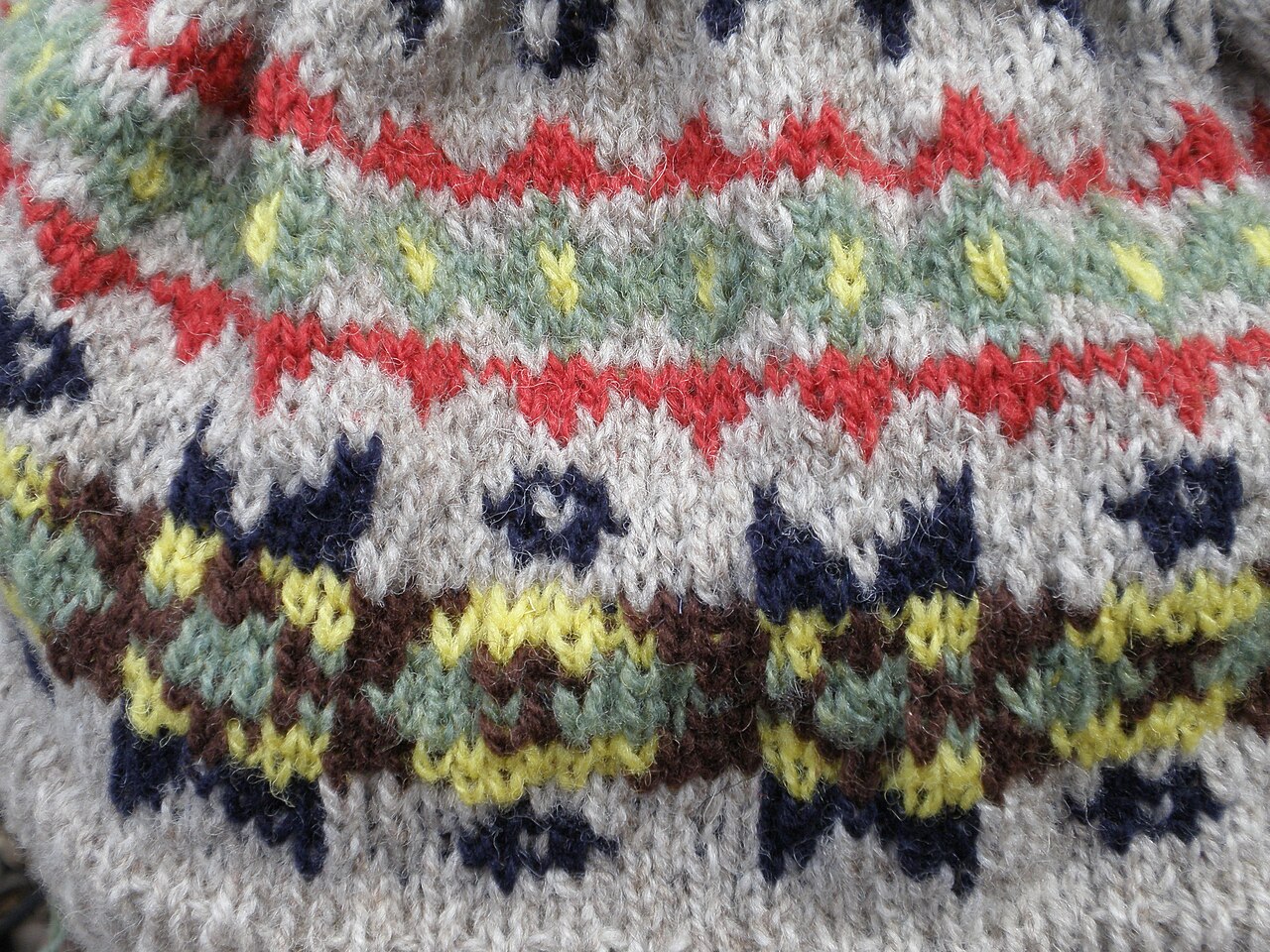
Colorwork knitting charts show which shade of yarn to use for each stitch. Colors may appear as shaded squares, outlined shapes, or symbols, and the key tells you which color is which, sometimes labeled MC (main color) and CC (contrast color). Colorwork charts are typically worked in stockinette stitch unless the pattern says otherwise, and they follow the same direction rules as any other chart.

Tips for Keeping Your Place on a Knitting Chart
- Use a sticky note or ruler. Place it just underneath the row you are working on and move it up as you finish each row.
- Mark off completed rows. A pencil tick or paperclip helps you pick up where you left off.
- Use stitch markers. Mark repeats, and for cables, mark where a cable begins and ends.
- Study the chart before you cast on. Look for multi-stitch symbols like cables so nothing surprises you mid-row.
If you come across an unfamiliar abbreviation in a written section of a pattern, our Knitting Dictionary can help, and our Help page is always there if you have questions about a Darling Jadore pattern.
Frequently Asked Questions
Do you read a knitting chart from right to left or left to right?
For flat knitting, read right side rows from right to left and wrong side rows from left to right. For knitting in the round, read every round from right to left.
Where do I start reading a knitting chart?
Start at the bottom right corner and work upward, unless your pattern tells you otherwise.
Why does the same symbol mean knit on one row and purl on another?
Charts show the fabric from the right side. On wrong side rows you are working from the back, so a stitch that appears as a knit on the front must be purled from the back.
What does a grey square mean on a knitting chart?
Often it is a no stitch square, a placeholder you skip entirely. In some colorwork charts, though, grey represents a color, so always check the key.